If you specify, buy, or maintain industrial furnace linings, vacuum-formed ceramic fiber modules are the format that has steadily replaced layered blanket and dense brick across heat-treatment and batch-furnace duty. A module is not a loose insulation material but a rigid, dimensionally accurate component: it insulates the furnace, supports the heating elements, and in many designs acts as the hot face itself. FeroHeat Innovators manufactures these modules in Bangalore under the FHL-VAC® range, in flat, embedded-element, free-radiating, and cylindrical formats, with custom shapes machined to drawing. The FHL Modular Heating System uses asbestos-free fiber, which matters for installer safety during fitting and future relines, and FeroHeat's element-and-ceramic-insulator combinations are engineered together as complete systems rated for duty from 20–2000°C. This guide explains how the modules are made, how to read the three FHL-VAC® grades on a datasheet, how thermal conductivity varies across the temperature range, which formats and sizes exist, and how to select the right module for a given furnace. Modules can also be supplied as complete engineered linings; because panels, elements, and support ceramics come from the same factory, the interfaces are engineered together rather than improvised at site. If you are weighing modules against a brick lining, the companion comparison article linked at the end of this guide runs those numbers side by side.
How do vacuum-formed ceramic fiber modules work?
A module begins as a water-based slurry: chopped alumino-silicate or high-alumina fiber dispersed with organic and inorganic binders. A perforated mold shaped like the finished component sits in the slurry while vacuum pulls the water through it, compacting the fibers evenly against the mold surface. After drying, and machining where required, three properties fall directly out of that process. First, density is controlled at the mold, so every module leaves the factory at a uniform 200–240 kg/m³ rather than whatever compression a site installer happened to achieve. Second, because the fibers interlock mechanically during forming, the module is rigid and self-supporting: it holds its geometry at temperature and resists erosion from high-velocity furnace gases far better than blanket, which can sag, shrink open at joints, and devitrify unevenly in service. Third, complex three-dimensional geometry costs essentially nothing extra — element grooves, thermocouple ports, peep sights, curved segment rings, and one-piece cylinders all emerge from the same forming step. Ceramic fiber blanket is flexible and inexpensive but must be layered, compressed, and anchored at site; pressed boards are strong yet comparatively dense, brittle, and largely limited to flat shapes. Vacuum forming sits deliberately between them: the shape freedom of a site-built blanket lining with the dimensional control of a machined board. That combination is why the format dominates modern low-mass furnace design. Drying drives off the free water and cures the binder system; the face that formed against the mold becomes the smooth, erosion-resistant working surface, and mating faces can be machined so panel joints close tightly in service.
Which FHL-VAC® grade does your furnace need: FHL-M 1150, FHL-Z 1325, or FHL-HT 1550?
FHL-VAC® Module Grades — Technical Data
| Parameter | FHL-M 1150 | FHL-Z 1325 | FHL-HT 1550 |
|---|---|---|---|
| Classification temperature (°C) | 1260 | 1425 | 1650 |
| Max. continuous working temperature (°C) | 1150 | 1325 | 1550 |
| Density range (kg/m³) | 200–240 | 200–240 | 200–240 |
| Linear shrinkage % (24 h at continuous working temp.) | < 1 | < 1 | < 1 |
| Al₂O₃ content (%) | 47 | 37.5 | 66 |
| Zr content (%) | — | 13 | — |
Read the grade table by the second row, not the first. Classification temperature is a standardized rating, but the figure that governs lining life is the maximum continuous working temperature. Running FHL-M 1150 at a steady 1100°C is sound practice; running it at 1250°C because the classification reads 1260°C will cost you shrinkage, open joints, and shortened lining life. Between the grades, composition tracks duty: FHL-Z 1325 carries 13% zirconia for reheating and forge-furnace service, while FHL-HT 1550 is a 66% alumina grade built for high-temperature kilns and laboratory furnaces. Thermal conductivity is equally temperature-dependent. All three grades start at 0.065 W/mK at 200°C mean temperature and reach 0.24–0.28 W/mK at 1000°C; the high-alumina FHL-HT 1550 is actually the best insulator of the three at elevated temperature, holding 0.33 W/mK at 1200°C, 0.39 W/mK at 1300°C, and just 0.51 W/mK at 1500°C. When you size a wall thickness, always use conductivity at the mean wall temperature rather than the hot-face temperature, and verify against the full conductivity table on the product datasheet before issuing the lining specification. Leave a margin for cyclic over-temperature — instruments overshoot and thermocouples drift — so a furnace nominally holding 1100°C is often better served by FHL-Z 1325 than FHL-M 1150. And remember that shrinkage acts at every joint: at 1% linear change a 950 mm panel moves nearly 10 mm, which is exactly why the sub-1% figure matters for keeping a modular lining gas-tight through the campaign.
What should you check first on a ceramic fiber module datasheet?
- Maximum continuous working temperature, not just classification temperature — classifying at 1260°C does not mean operating continuously at 1260°C.
- Linear shrinkage at your actual holding temperature: every FHL-VAC® grade holds below 1% after 24 hours at its continuous working temperature, which keeps joints closed and hot spots away.
- Thermal conductivity at the mean wall temperature — 0.24–0.28 W/mK at 1000°C across the FHL-VAC® range, rising to about 0.48 W/mK at 1300°C for the standard grades.
- Density consistency: the full range runs 200–240 kg/m³, so heat storage and structural load stay predictable across grades and panel thicknesses.
- Hot-face erosion resistance where burners or high-velocity gases impinge directly on the lining surface.
- Standard sizes with factory machining: standard 950 × 950 mm boards keep costs down, and grooves, ports, and cut-outs are best specified with the order rather than cut at site.
- Chemical compatibility with the furnace atmosphere, including reducing atmospheres and flux vapors.
What formats and sizes do FHL-VAC® modules come in — and where are they used?
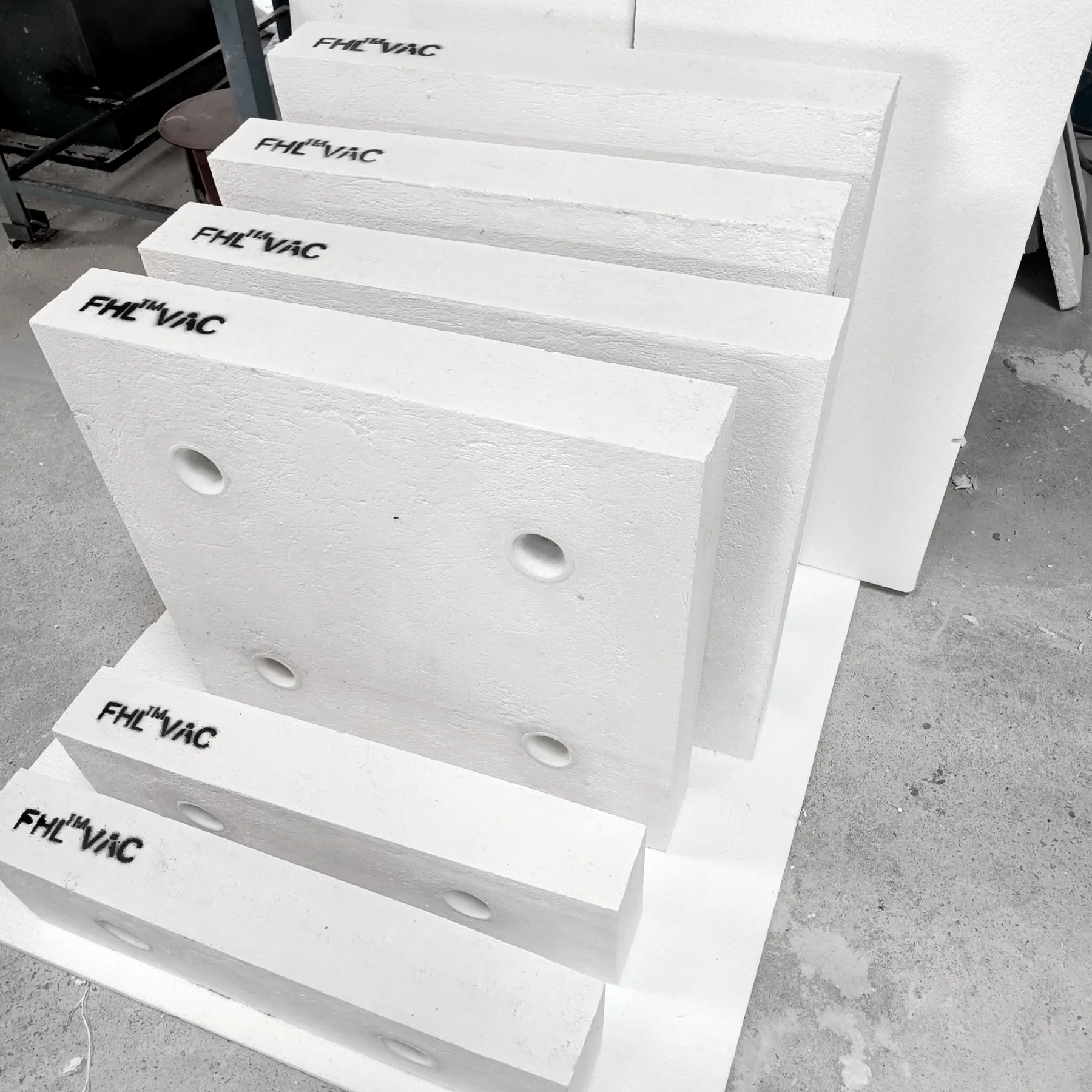
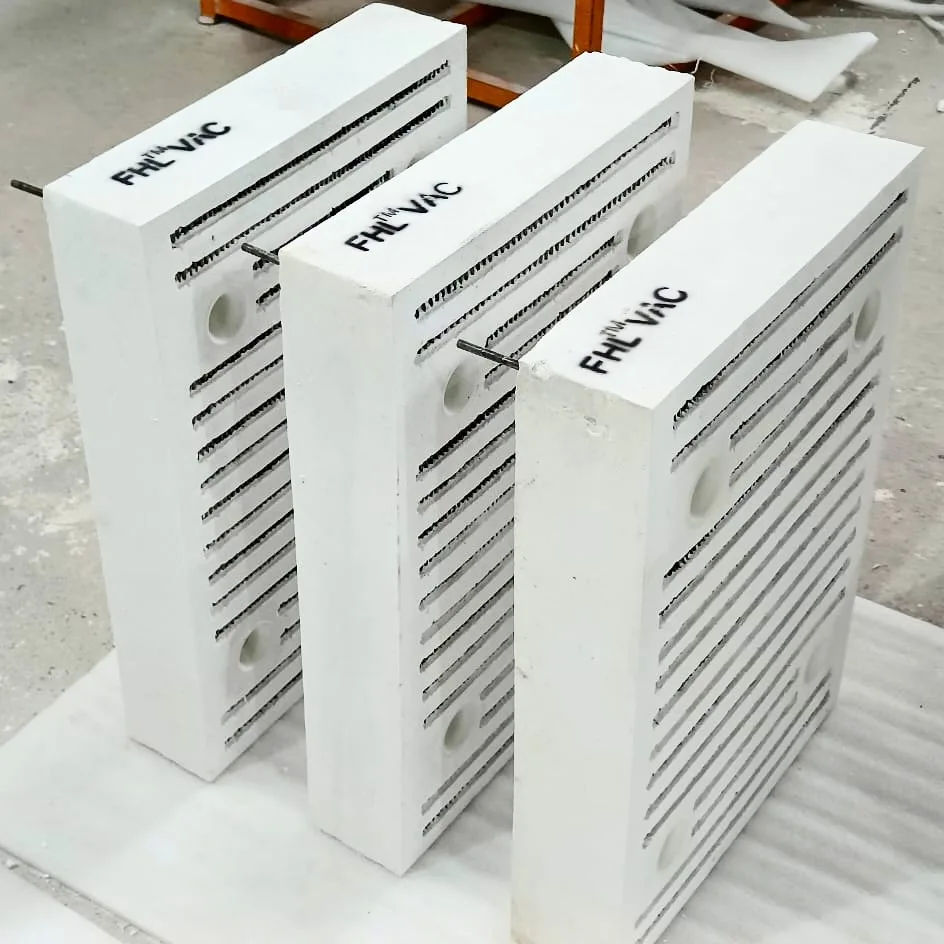
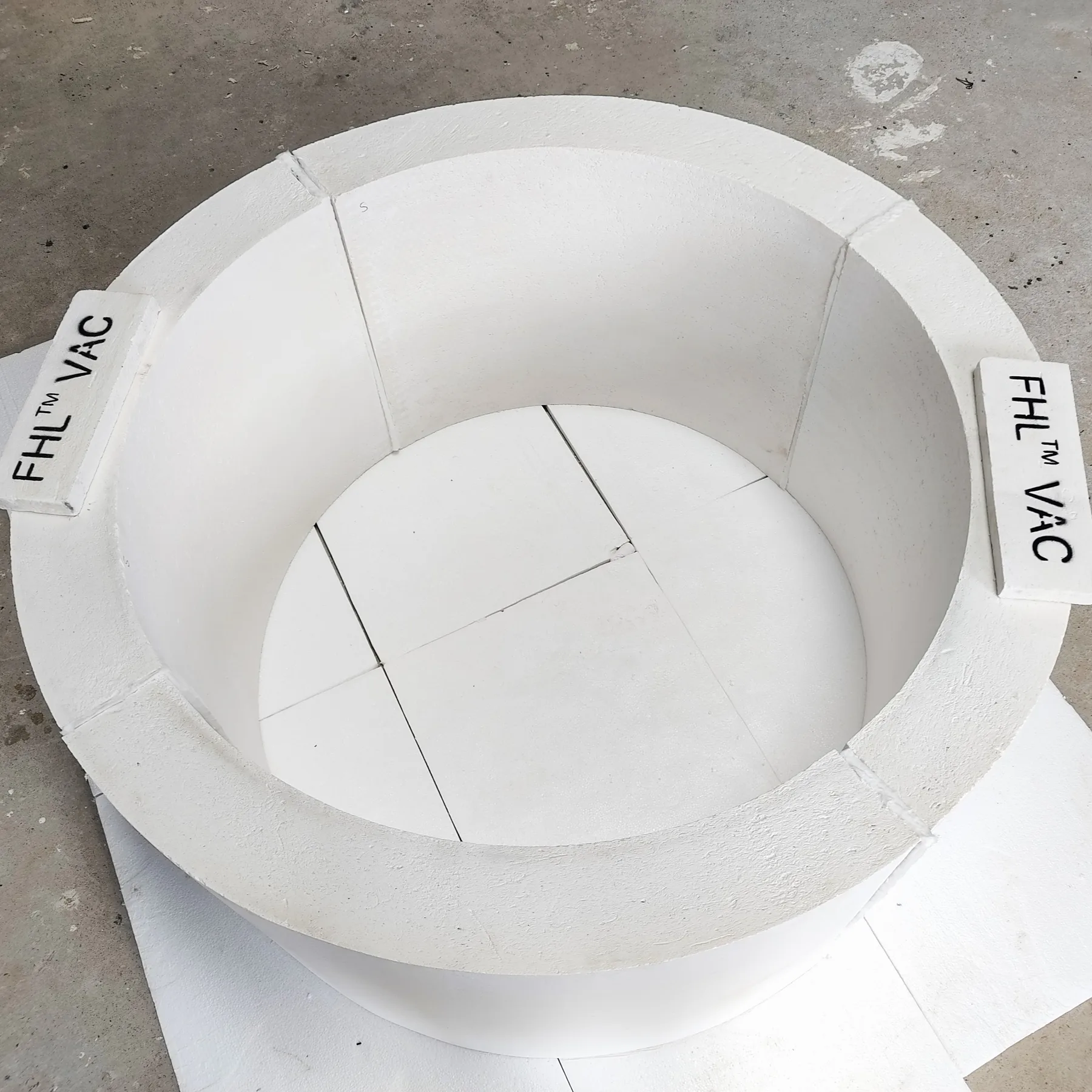
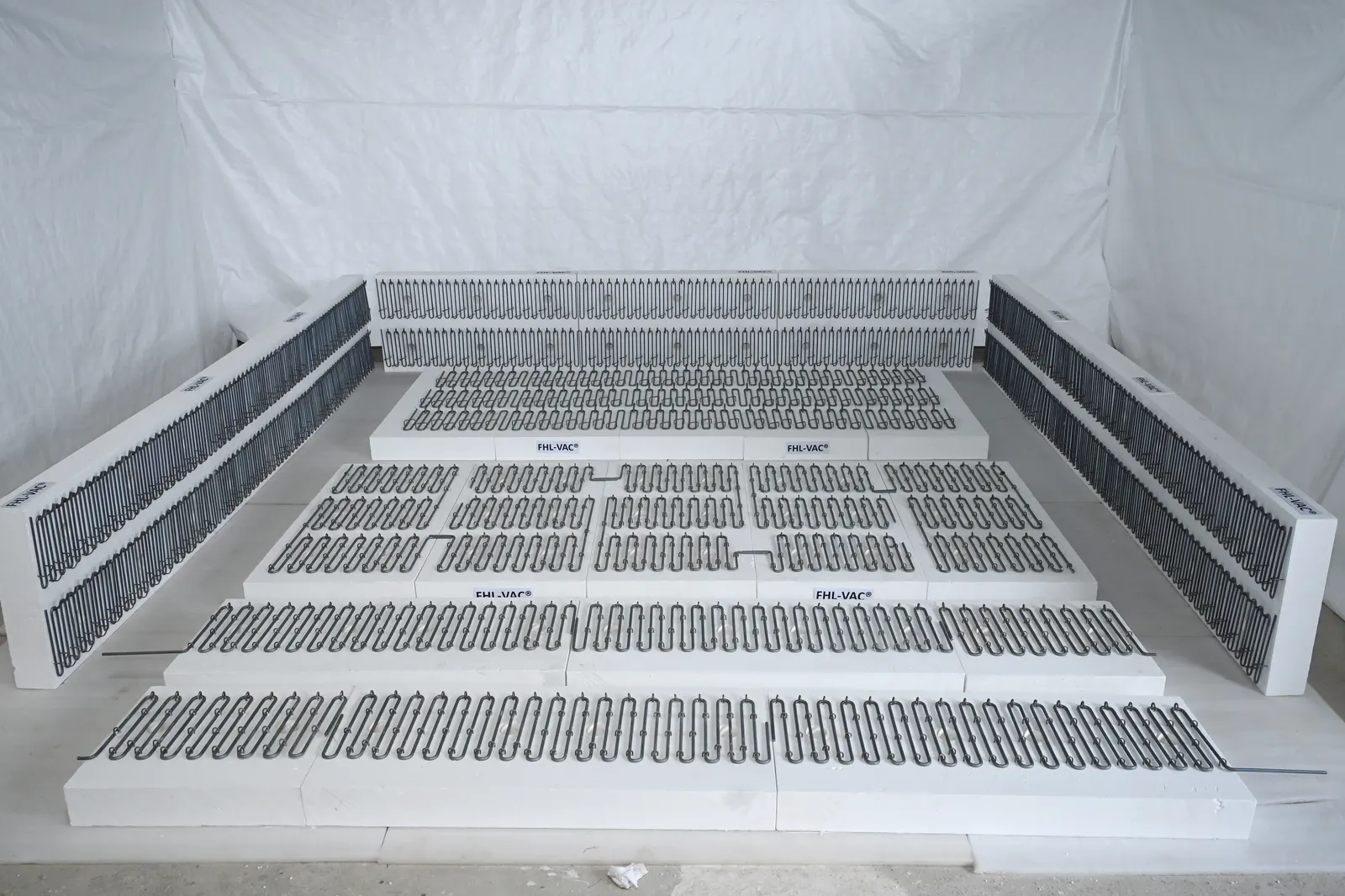
Standard FHL-VAC® flat insulation panels are boards up to 950 × 950 mm in 90, 100, and 125 mm thicknesses; FHL-VAC® free-radiating panels add a 150 mm option for higher-powered walls and roofs. FHL-VAC® cylindrical insulation segments are formed from 100 mm internal diameter upward, so small muffle tubes and large bell furnaces alike can be lined with matched rings instead of cut blanket, while FHL-VAC® insulation cylinders provide seamless one-piece hot-face linings for tube and laboratory furnaces — plain, grooved for windings, or with embedded elements. FHL-VAC® embedded flat panels go a step further still: FHL® resistance elements are bonded directly into the module, so insulation and heat source arrive as one factory-assembled unit with the element protected from handling damage throughout its working life. Where do these modules earn their keep? Anywhere cycle time and energy per tonne decide profitability — aluminum processing, automotive and aerospace heat treatment, foundry and forge reheating, glass-industry lehrs, and laboratory furnaces. A module lining stores a fraction of the heat of a dense refractory lining, so batch furnaces heat up faster, soak with less overshoot, and cool quickly enough to support double-shift schedules. FeroHeat's R&D capability spans 20–2000°C, so the same module technology also serves researchers who need custom shapes in small quantities rather than full furnace linings. For furnaces with existing steelwork, matching panel thickness to the available cavity often decides whether a reline can reuse the shell; the 90–150 mm thickness range covers most retrofits without structural changes, and roofs and doors benefit twice from the low mass because every kilogram removed there also cuts bending loads and wear on lifting gear. Send your furnace drawings and cycle data to info@feroheat.com or call +91 93413 52747 for a grade, thickness, and format recommendation before you commit to a lining.
Key takeaways
- Vacuum-formed ceramic fiber modules are rigid, precision-shaped furnace lining components made by dewatering a fiber-and-binder slurry on a perforated mold under vacuum.
- FeroHeat's FHL-VAC® range covers three grades — FHL-M 1150, FHL-Z 1325, and FHL-HT 1550 — with maximum continuous working temperatures of 1150°C, 1325°C, and 1550°C.
- All three FHL-VAC® grades share a density of 200–240 kg/m³ and linear shrinkage below 1% after 24 hours at the continuous working temperature.
- Always select a module grade by its maximum continuous working temperature, never by its higher classification temperature.
- FHL-VAC® thermal conductivity rises from 0.065 W/mK at 200°C mean temperature to 0.24–0.28 W/mK at 1000°C, still several times lower than typical dense firebrick.
- Embedded and free-radiating FHL-VAC® panels integrate FHL® heating elements into the insulation, delivering a complete heated furnace wall in one factory-assembled unit.
Frequently asked questions
What is a vacuum-formed ceramic fiber module?
A vacuum-formed ceramic fiber module is a rigid furnace-lining component made by drawing a slurry of ceramic fiber and binders onto a perforated mold under vacuum, then drying it. The result is a self-supporting board or shape at 200–240 kg/m³, such as FeroHeat's FHL-VAC® panels, which insulate the furnace and can also support or carry heating elements.
What temperature can vacuum-formed ceramic fiber modules withstand?
FeroHeat's FHL-VAC® modules are rated by maximum continuous working temperature: 1150°C for FHL-M 1150, 1325°C for FHL-Z 1325, and 1550°C for FHL-HT 1550. Classification temperatures run higher — 1260°C, 1425°C, and 1650°C respectively — but continuous duty should always be sized on the working-temperature figure.
Are FHL-VAC® ceramic fiber modules safe to handle?
Yes. FHL-VAC® modules are part of the FHL Modular Heating System and use asbestos-free ceramic fiber. Ordinary workshop hygiene — gloves, dust control when cutting, and extraction during machining — remains good practice during fitting and later repairs.
What sizes do FHL-VAC® panels and cylinders come in?
Flat FHL-VAC® panels are boards up to 950 × 950 mm in 90, 100, and 125 mm thicknesses, with 150 mm available on FHL-VAC® free-radiating panels. Cylindrical segments and one-piece insulation cylinders run from 100 mm internal diameter upward. Custom dimensions, element grooves, thermocouple ports, and machined details are available on request.
How do I choose between FHL-M 1150, FHL-Z 1325, and FHL-HT 1550?
Select on maximum continuous working temperature with a sensible margin: FHL-M 1150 for duty up to 1150°C, FHL-Z 1325 for reheating and forge service to 1325°C, and FHL-HT 1550 for kilns and laboratory furnaces to 1550°C. Share your cycle data with FeroHeat's engineers to confirm grade, thickness, and module format.
Written by the FeroHeat Engineering Team. Technically reviewed by Pranesh Kumar, Technical Director.